
When Bonds Become the Story
When Bonds Become the Story
Markets spent much of 2026 debating artificial intelligence, geopolitics and economic resilience, but last week the bond market reclaimed centre stage. The move was striking not simply because government bond yields rose, but because they reached levels that are beginning to reshape investor behaviour, government finances and market expectations across the globe.
The week began with US 10-year Treasury yields opening at 5.20%, their highest level in 19 years, before climbing to 5.27%. Long-dated inflation-linked Treasuries also reached record real yields, highlighting the compensation investors are demanding to lend to governments for longer periods. While higher yields can reflect confidence in economic growth, the speed of the move has become the market's primary concern.
Financial markets have absorbed the shock relatively well so far. US equities remain close to their highs and credit markets have shown little sign of stress. Yet history suggests large moves in bond markets eventually have consequences elsewhere. The key question is not whether higher yields matter, but where the pressure will emerge first.
Europe increasingly looks like one answer. France moved to the forefront of investor concerns after announcing plans for record borrowing in 2027. The response was swift: French government bond yields rose sharply and the spread over German bonds widened towards levels last seen during the eurozone sovereign debt crisis. Commentary that would have seemed alarmist only months ago, discussing the possibility of another eurozone debt crisis, entered mainstream market debate.
The comparison with Greece is not exact, but investors are focusing on familiar issues: high debt levels, rising borrowing costs and political uncertainty. With French presidential elections approaching next year and support growing for parties on both the left and right, markets are increasingly questioning how easily the government can improve its fiscal position. Whether this develops into a broader crisis remains uncertain, but France has become Europe's most closely watched bond market.
Announcements from UK Prime Minister Andy Burnham point to the same underlying theme. His decision to soften the long-standing "triple lock" pension commitment, which guarantees that public pensions rise each year by the highest of inflation, suggests rising borrowing costs are forcing governments to confront fiscal choices that were easier to postpone when money was effectively free. Bond markets are becoming less willing to accommodate expansive spending plans without asking how they will be funded.
In the United States, meanwhile, there were tentative signs that the recent sell-off may have gone slightly too far. Markets moderated expectations for further Federal Reserve tightening after policymakers suggested there was still time to assess whether additional rate rises were necessary. Treasury yields eased somewhat from their highs, though few investors expect a return to the ultra-low-rate environment that followed the Global Financial Crisis.
One of the more intriguing developments of the week was the contrast between economic data and public sentiment. Consumer confidence fell sharply, reaching some of the weakest readings seen in the five decades the Conference Board has been conducting its survey, despite continued evidence that the US economy remains resilient. Growth estimates remain robust and employment conditions broadly healthy, yet households appear far more pessimistic than the economic data might suggest. This disconnect has become an increasingly important feature of the post-pandemic economy and may carry both political and economic implications.
A contributing factor may be energy prices, which remain another source of inflation anxiety. Hopes of progress towards an agreement involving Iran and shipping through the Strait of Hormuz faded, helping keep Brent crude around $104 a barrel. Elevated energy prices sit uncomfortably alongside already-high borrowing costs and complicate the task facing central banks seeking to control inflation without unnecessarily damaging growth.
Against this backdrop, enthusiasm for artificial intelligence showed little sign of fading. Reports that Anthropic and OpenAI are considering public listings at enormous valuations demonstrate that investors remain willing to look beyond near-term macroeconomic concerns when assessing long-term technological opportunities. Yet even within AI, the conversation is becoming more nuanced, with safety concerns and regulation receiving increasing attention.
In our view, what stands out about the week is how many seemingly unrelated stories were linked by the same underlying force. From French government finances to oil prices and equity valuations, higher bond yields were the common thread.
The developments in France also reinforce a theme that has shaped our fixed income positioning for several years. Rather than owning traditional long-duration government bonds, we have preferred subordinated debt issued by well-capitalised financial institutions, high-quality corporate bonds and selected emerging market sovereigns with a track record of fiscal and monetary discipline. Recent events highlight why that distinction has mattered, although G7 yields at multi-decade highs may mean government bonds are becoming increasingly difficult to ignore.
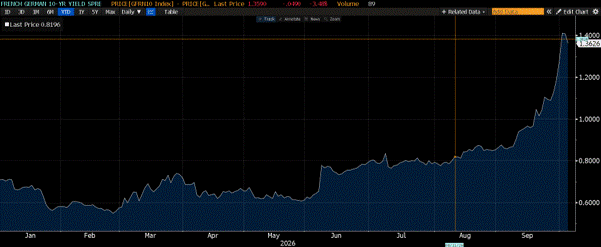
Chart of the Week: France's Warning Signal (Source: Bloomberg)
The French-German 10-year yield spread tells us how much extra investors demand to lend to France rather than Germany, the eurozone's benchmark safe haven. Its sharp rise this year, and particularly in recent weeks, reflects growing unease over France's fiscal outlook and the government's plans for record borrowing. Showing that the bond market is no longer treating all eurozone sovereign debt equally. As global yields continue to rise, France has emerged as Europe's clearest pressure point, making this spread one of the most important indicators to watch.