
Resilient Growth, Narrower Leadership
Weekly article: 21st-25th September
The story of the week was a global rethink of interest rates. It began in the US on Wednesday, when the S&P Global’s flash Purchasing Manager Index (PMI) rose to 58.4, the fastest private-sector growth in more than five years. Input costs rose at the steepest pace in four years, and firms reported some of the worst supply bottlenecks in the survey’s history. For a Federal Reserve who raised interest rates only a week earlier, that is an awkward mix and the data strengthened expectations that policymakers may need to tighten again.
Staying in the US, Treasury markets felt the pressure, with the 10-year yield rising to 5.2%, while weaker demand at five and seven-year government bond auctions added to concerns over how much yield investors will demand to keep financing the US deficit. Consumers are feeling the squeeze too, with sentiment falling to a four-month low as higher fuel prices, tariffs and borrowing costs weigh on household finances, much like the rest of the world.
Trade and AI provided the counterweight. Chinese President, Xi Jinping travelled to Washington for his first US state visit in 11 years, with the two sides extending their trade truce until January 10th, 2027, and announcing progress across agricultural goods, medical devices, selected consumer products and artificial intelligence. Larger disagreements remain unresolved, but Wall Street welcomed the reduction in near-term uncertainty. This helped the S&P 500, and the Nasdaq indices push ahead, with AI related names again leading the way. Meta was the standout name, surging 13% after launching Muse, its personal AI agent, taking it close to record highs. Microsoft also rose 4.5% on a revamped Copilot platform, and memory maker Micron rose 6.5% ahead of results next week. On the flip side, defensive sectors such as utilities struggled on the back of higher yields.
Closer to home, Europe faced the same monetary pressures but against a softer economic backdrop. However, Eurozone activity did expand at its fastest pace in more than three years, helped by stronger conditions as Germany and France returned to growth. The UK was more subdued, with PMI easing to 51.7, although inflation at 3.1% remains high enough to keep the Bank of England cautious. That tension showed up in bond markets, where the UK 10-year gilt reached 5.36% and the German equivalent rose to 3.61%. interestingly, the UK 2-year yield barely budged, suggesting that investors are less worried about the next Bank of England rate decision than about long-term inflation and government borrowing ahead of the autumn budget. Equities were steadier, the STOXX 600 gained 0.5% and the FTSE 100 added 0.3%, mostly driven by Banks being helped with higher interest rates.
Turning East, Japan offered another sign of how dramatically the global rate environment has changed. The Bank of Japan had already lifted rates to 1.25%, their highest in more than 30 years, while the Japanese 10-year government bond yield moved above 3%. Even so, the Nikkei gained 2.1% in a holiday shortened week, supported by the Bank sector and a weaker Yen. Chinese equities were less enthusiastic about the Washington talks, with investors having hoped for a longer trade truce than the two-month extension eventually agreed.
Energy markets delivered some welcome relief. Brent Crude fell 5.6% to $97.44 a barrel, and WTI Crude dropped to $92.41 as diplomatic discussions involving Iran and the Strait of Hormuz improved and Saudi pipeline flows recovered. A sustained fall in oil prices would matter well beyond commodity markets, easing pressure on transport, manufacturing and household costs at a time when energy remains a key complication for central banks. Precious metals also suffered on the week, with gold and silver down 2.1% and 3% respectively as higher bond yields and a stronger dollar increased the opportunity cost of holding assets that produce no income.
On the contrary, digital assets enjoyed a stronger week, although most of the excitement came early in the week. Bitcoin briefly traded above $87,000, it's highest since January, after more than $800 million of short positions were forced to close and US spot Bitcoin ETFs attracted close to $1 billion in a single day. The soaring bond yields later cooled the move, but Bitcoin still finished around 4% higher, with other majors following suit such as Ethereum gaining 1.7% and Solana nearly 10%. The pattern remains familiar; crypto still trades as a gauge of risk appetite rather than a shelter from rising rates.
The broader picture is therefore one of resilient growth meeting tighter financial conditions. Equity markets continue to reward businesses capable of delivering strong earnings growth, particularly around AI. However, cash and fixed income investments are once again credible alternatives for investors rather than being simply defensive in nature.
Turning our attention to the week ahead, Micron reports earnings on Wednesday, with investors likely to focus closely on demand for high-bandwidth memory, pricing and data centre spending for clues as to whether the AI investment cycle still has momentum. Revised UK second-quarter GDP figures are also due Wednesday, before US manufacturing data arrives on Thursday. Friday then brings two potentially important signals for the rates outlook. The September US employment report and the euro-area flash inflation reading. Together, they should provide the next test of whether strong growth can continue without forcing central banks even further into restrictive territory.
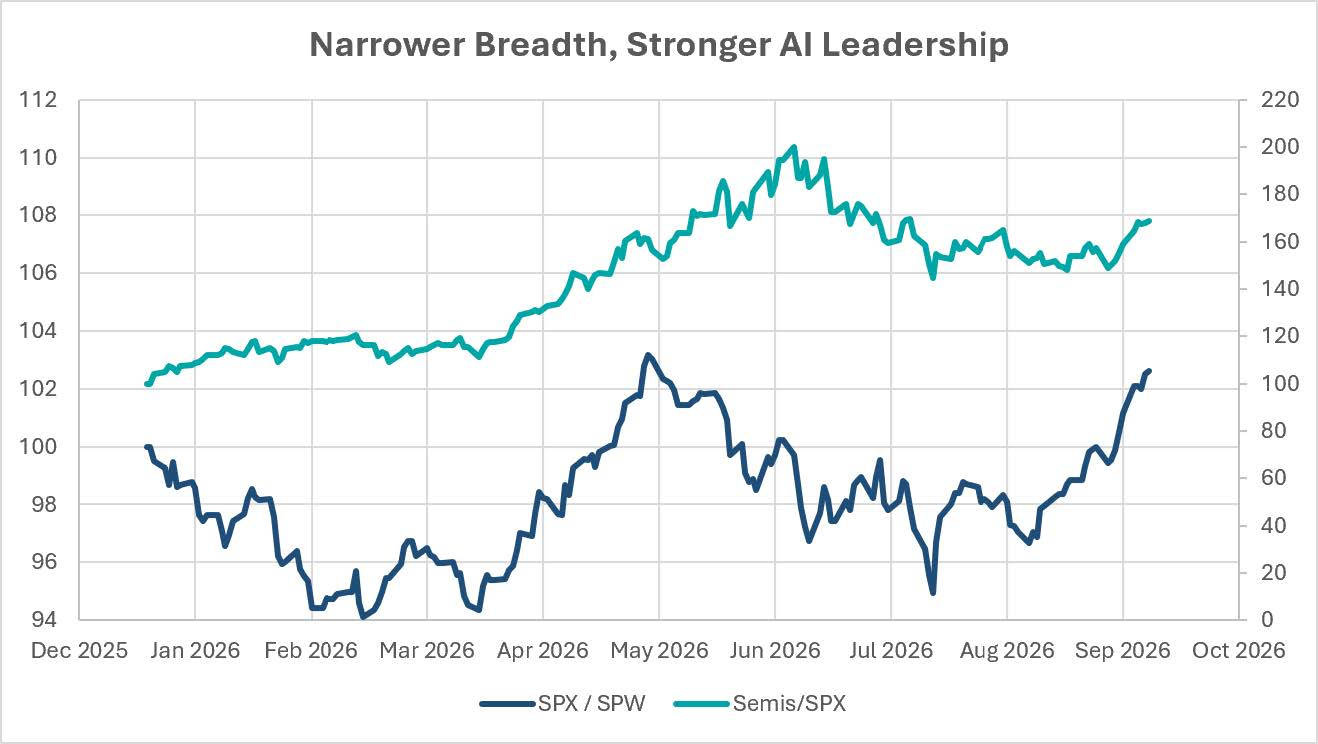 (Source: TEAM)
Beneath the headline strength of the S&P 500, market leadership has become increasingly concentrated. The S&P 500 has moved higher relative to its equal weighted counterpart (left-hand side axis), indicating that the largest constituents are once again doing a disproportionate share of the work. At the same time, semiconductors (the AI names), continue to outperform the S&P 500 (right hand side axis), reinforcing the importance of the AI and data-centre investment theme in driving the US equity returns. Taken together, the two series suggest that while the index remains strong, the rally is leaning more heavily on a narrower group of market leaders.