
The AI Bill Comes Due
Global financial markets spent much of last week wrestling with an uncomfortable question: what happens when investors stop caring about artificial intelligence growth and start caring about the bill for its development?
For much of the past two years, markets have rewarded almost any company willing to spend aggressively on AI infrastructure. Data centres, semiconductor capacity and cloud computing have been viewed as essential investments rather than optional luxuries. Last week suggested that mentality may be starting to shift.
The alarming rate of cash flow burn by the so-called hyperscalers (giant tech companies like Microsoft, Amazon and Google that own massive networks of data centres) pursuing AI dominance has put additional weight on the importance of corporate earnings results and guidance, specifically the potential path to AI profitability for shareholders.
Heading into results season, semiconductor shares had already come under pressure as investors questioned whether AI investment had become too concentrated. For the first time, investors appeared more impressed by balance sheet restraint than ambition. Microsoft surged after signalling a more disciplined approach to capital expenditure, while Meta moved sharply lower as investors reacted negatively to continued spending commitments despite management's confidence in long-term AI opportunities.
The message was subtle but important. During the early stages of an investment cycle, markets reward growth almost regardless of cost. Eventually, investors begin asking harder questions about returns. Last week felt like one of the first genuine signs that parts of the market are entering that second phase.
None of this means the AI trade is over. Despite a near 10% decline from its peak, the Nasdaq remains close to record highs, semiconductor demand remains robust, and the broader AI ecosystem continues to benefit sectors far beyond technology. Metals, power infrastructure, industrial automation and selected international markets continue to see meaningful tailwinds from the AI build-out.
Turning to geopolitics, the increasingly fragile US-Iran diplomatic situation took another twist courtesy of Yemen, where Houthi rebels are reportedly considering transit charges for vessels using the Bab el-Mandeb Strait, through which an estimated 10-12% of global trade passes.
Traffic through the route has increased since tensions around the Strait of Hormuz emerged earlier this year, helping alleviate some of the disruption to global energy flows. Any meaningful interruption would force vessels onto far longer routes around the Cape of Good Hope, increasing costs, delays and inflationary pressure across supply chains.
For central banks, that scenario is an uncomfortable prospect. The Federal Reserve left interest rates unchanged last Wednesday, although three members voted for an immediate hike, underlining persistent concerns around inflation. Chairman Kevin Warsh once again left investors scratching their heads during a press conference that many viewed as more confusing than clarifying. If the goal was to reduce forward guidance and force markets to focus on incoming real-time data, then perhaps the mission was accomplished.
Bond markets reacted negatively to Warsh's formal FOMC (Federal Open Market Committee) statement, which painted a picture of a defiant Fed determined to bring inflation back to its 2% target. Real Treasury yields climbed to their highest level since the Global Financial Crisis, while volatility surged across asset classes. Earlier this year, investors were confidently pricing rate cuts. Today, markets are increasingly contemplating the prospect of rates remaining higher for longer.
In summary, last week felt less like a rejection of the AI narrative and more like the beginning of a new chapter. Investors are no longer asking whether artificial intelligence will change the economy. They are asking who will ultimately earn an attractive return from the extraordinary sums currently being invested.
At the same time, the familiar tensions of 2026 remain very much alive. Geopolitical risks continue to threaten global supply chains, inflation risks have not disappeared, and central bankers remain reluctant to declare victory.
This is one reason our own equity positioning has remained diversified across sectors, with an emphasis on complementary exposure outside of the AI theme. While we have never been heavily concentrated in the largest technology names, we continue to see opportunities in areas benefiting from the same structural trends, including industrial metals, infrastructure and Japan.
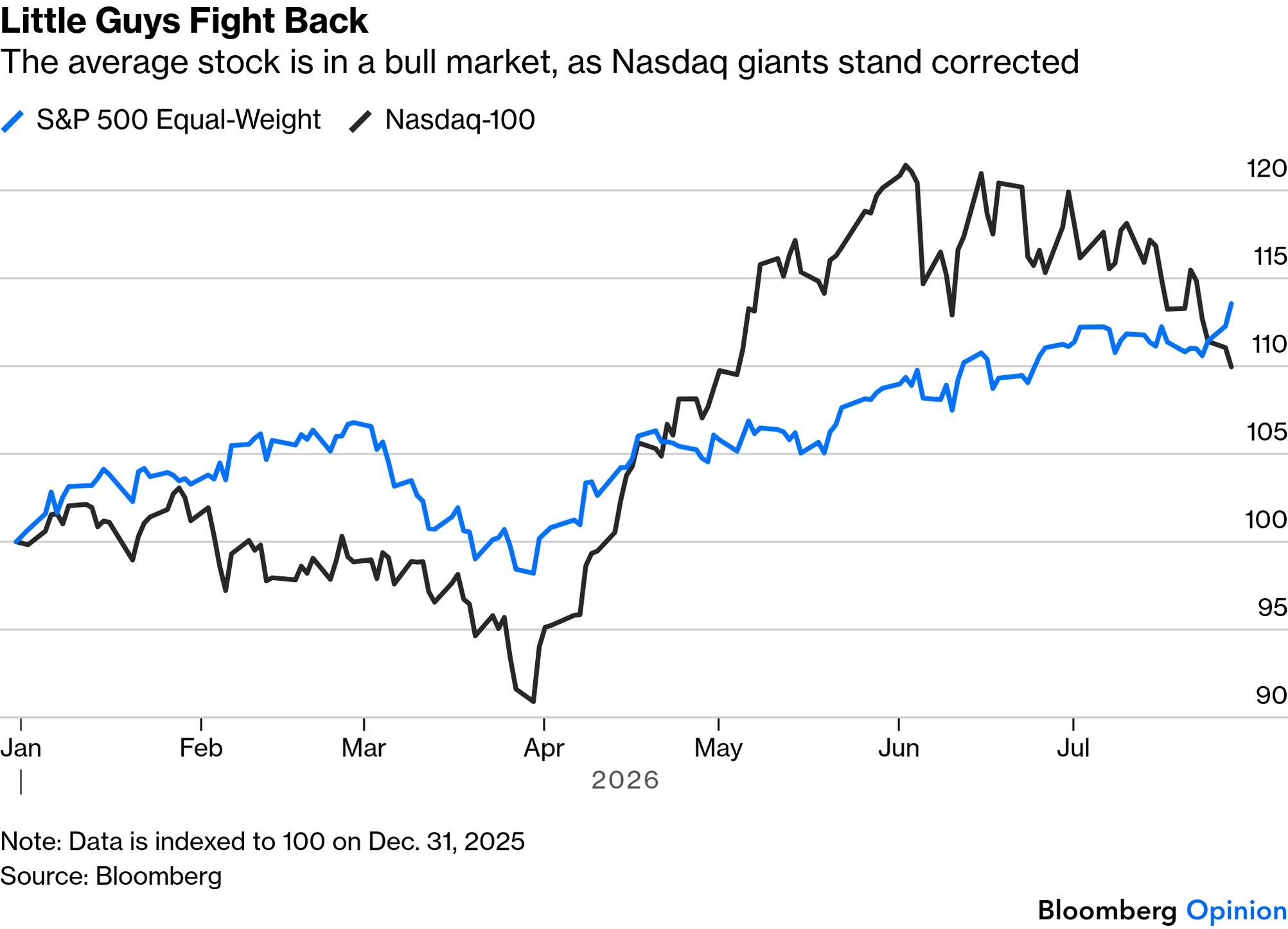 (Source: Bloomberg, John Authors)
The chart highlights a notable shift in market leadership during 2026, with smaller and more broadly distributed stocks beginning to outperform the technology-heavy Nasdaq-100. While the Nasdaq-100 surged sharply from April into June, it has since retreated, ending around 110 on the index, down from its peak near 120. In contrast, the S&P 500 Equal-Weight Index has steadily climbed, reaching roughly 112 and outperforming the Nasdaq-100 in recent weeks. This divergence suggests that market strength is broadening beyond the mega-cap technology stocks that have driven much of the rally, indicating that smaller companies may finally be starting to “fight back.”