
Semiconductor selloff almost as ugly as Argentina’s tackling
Much like this weekend’s World Cup finals, the most compelling action was away from the headline event. Spain lifted the trophy for a second time after a subdued final against Argentina, while England’s ten-goal Bronze Final win over France provided the real spectacle. Markets followed a similar pattern: headline indices moved modestly, but beneath the surface the week was far more eventful, with diversification rewarded more clearly than it has been for some time.
The key economic release was June’s US inflation report, which came in below expectations and offered the first genuinely encouraging disinflationary signal in a cycle that has kept the Federal Reserve on alert. Even so, policymakers remained divided on what it meant.
Chair Warsh took the more hawkish view, stressing that the Fed would not tolerate persistent inflation and giving little sense that an immediate pause was likely. New York Fed President Williams sounded more receptive, describing the data as encouraging, but also raised a new question: whether AI-related price pressures could influence inflation in ways existing policy frameworks are not designed to capture. Markets settled somewhere in the middle. Expectations for further rate increases were reduced but not abandoned. One softer report was helpful, but not decisive.
In the UK, markets absorbed the political transition with little disruption as Andy Burnham became Labour leader and prime minister designate. The FTSE 100 was largely unmoved by the change, ending the week just under 1% higher, supported by strength in energy companies.
Further east, Japan faced the possibility of higher core inflation, while China left loan prime rates unchanged and continued to struggle with weak foreign direct investment. Asian markets were notably weaker: the Nikkei fell -6.44% and China’s Shanghai Composite declined -5.81%, driven by a broad semiconductor selloff. Emerging Chinese AI models prompted investors to question whether US companies can maintain an unchallenged lead across every part of the technology supply chain. Collectively, the data pointed to a global economy still cautiously holding its breath.
That caution was also visible in US equities. The S&P 500, Nasdaq and Dow Jones all finished lower, down -1.55%, -4.13% and -0.93% respectively. The moves were orderly by recent standards, but the composition mattered: investors continued to rotate away from AI and broader technology names.
At the same time, some of Wall Street’s oldest institutions opened earnings season with one of the strongest collective performances of the quarter. The six largest US banks delivered what the Street called a “$55 billion quarter”, supported by strong trading revenues, improving deal pipelines and the expanding use of AI across global markets businesses.
Bank of America appointed senior executives to integrate AI into its market’s operations, while Citigroup announced a $60 billion housing initiative. The message was clear: the established financial sector is not simply trying to survive the AI era; it intends to finance, implement and profit from it.
This contrast between traditional earnings strength and technology valuation anxiety defined the week. NVIDIA and Apple continued to trade places as the world’s most valuable company, with NVIDIA narrowly retaining the lead despite weakness in semiconductor shares. Microsoft entered the week before results with several analysts lowering price targets, reflecting growing impatience with the scale of Big Tech capital expenditure.
The question is no longer whether the largest technology companies believe in AI. Their hundreds of billions of dollars of infrastructure spending have answered that emphatically. Investors now want evidence that this spending can become durable revenue growth and attractive returns on capital.
The same tension is evident beyond the established giants. AI chip start-up Etched was reportedly raising capital at a valuation of about $20 billion, while enthusiasm around Chinese memory chip producer MXMT’s proposed $8.6 billion Shanghai listing was dampened by the sector selloff. Even the semiconductor IPO pipeline, once protected by the AI narrative, is now being tested.
Commodity markets were driven by a more concentrated force: geopolitics. WTI crude rose to $82 per barrel, while Brent gained 15.91% to just above $88, as tensions between the US and Iran escalated after Iranian strikes in Jordan killed two US servicemen, with another reported missing. Oil prices responded quickly as investors rebuilt a geopolitical risk premium that had gradually faded.
Gold’s muted response was therefore one of the week’s more surprising developments. Bullion ended at $4,017 per ounce, having briefly fallen below $4,000 to a weekly low of $3,976.50 before attracting late support on Friday.
The coming week is quieter on the macro front. The main releases are UK inflation on Wednesday, expected to ease by 0.1 percentage points to 2.7%. The ECB interest rate decision is on Thursday, where no change is forecast. However, earnings from Alphabet, Microsoft and Intel will place the central participants in the AI investment cycle back under scrutiny. Each will need to show that heavy infrastructure spending is beginning to deliver tangible commercial returns.
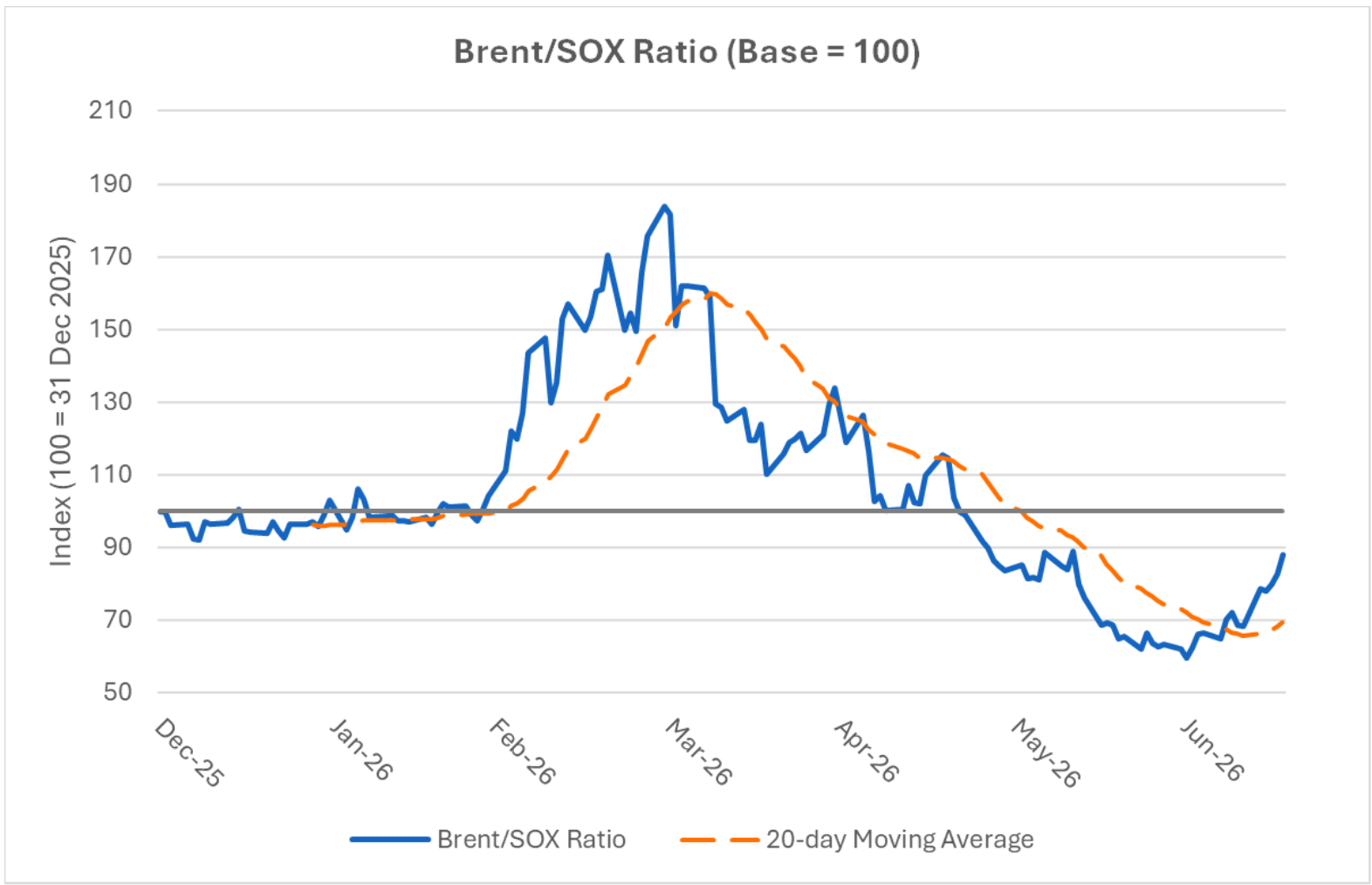
The Brent/SOX relative strength ratio compares oil with semiconductor equities, offering a useful gauge of where investor attention is being directed. A falling ratio reflects confidence in AI-led growth and technology leadership: a rising ratio points to a rotation towards energy, inflation protection and geopolitical risk.
After months of semiconductor dominance, the ratio has based and moved above its 20-day moving average. It remains the baseline of 100, so the longer-term leadership has not yet changed, but the sharp reversal suggests investors are beginning to question whether the next phase of market performance will be driven by solely by AI, or increasingly by the price of geopolitical uncertainty.