
The Cost of Money Starts to Matter
When the Cost of Money Starts to Matter
Global markets spent much of last week reassessing one assumption that has underpinned investor optimism for most of 2026: that interest rates are heading lower.
At the centre of the conversation was the annual international conference on economic policy hosted by the Federal Reserve Bank last week in Jackson Hole, where Federal Reserve Chairman Kevin Warsh continued to shape expectations for the next phase of US monetary policy. While markets had long since abandoned hopes of aggressive rate cuts, investors arrived looking for reassurance that inflation was finally under control. They left with the opposite impression.
Warsh's message was nuanced but clear. The Federal Reserve remains focused on future inflation risks and appears increasingly reluctant to declare victory simply because recent data has improved. The reaction was immediate. Bond yields rose across much of the developed world as investors pushed back expectations for monetary easing and began contemplating something that seemed highly unlikely only a few months ago: another US rate hike before year end.
Money markets now assign 90% probabilities to a Federal Reserve increase by December. That represents a remarkable shift from earlier this year, when discussions centred around the timing and scale of future cuts.
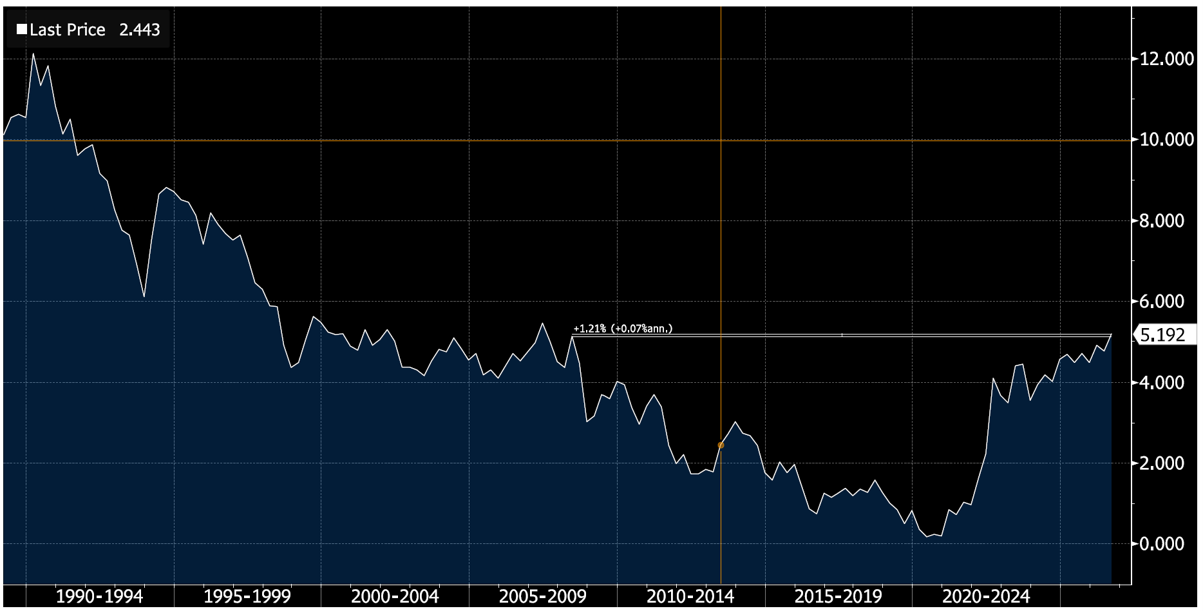
Bond markets did not stop at the United States. Borrowing costs continued to climb across much of the developed world, with UK gilt yields reaching their highest levels since the Global Financial Crisis and Japanese government bond yields touching levels not seen since the 1990s. What began earlier this year as a discussion around inflation is increasingly becoming a discussion around debt.
That matters because governments are carrying historically large debt burdens, far more than they were during previous monetary tightening cycles. Across the G7 economies, higher yields are expected to add tens of billions to annual debt servicing costs, creating an unwelcome challenge for policymakers already struggling to balance spending commitments, economic growth and voter expectations.
What stands out, however, is how little of this seems to concern equity investors. Despite the repricing in bond markets, equities remain remarkably resilient with investors instead concentrating on earnings, productivity and the longer-term opportunities created by structural growth themes such as artificial intelligence.
Within equity markets themselves, leadership continues to broaden. While technology remains a key driver of returns, investors are increasingly finding opportunities beyond the largest US mega-cap names. Many of the beneficiaries of the AI build-out are now appearing elsewhere in the market, from industrial metals and infrastructure providers to power generation and selected international markets.
That evolution is important because it reinforces a theme we have highlighted before: the AI story is becoming far larger than technology alone. The companies building networks, supplying raw materials and supporting industrial expansion are benefiting from many of the same structural forces.
Commodity markets provided a reminder that inflation risks have not entirely disappeared. Energy prices remained volatile throughout the week, even if they avoided the dramatic swings seen earlier this year. Geopolitics remains a background risk rather than a headline driver, but markets continue to monitor developments closely given their potential implications for trade routes, supply chains and inflation.
In Corporate news, Nvidia's quarterly earnings overshadowed everything else. The world's most valuable company revealed that its revenue rose 106% year-on-year to $96.2bn and data centre revenue more than doubled to $89bn, highlighting the exceptional demand for AI infrastructure. Investors were impressed and Nvidia's shares rose 8.7% the following day, adding around $441bn to its market valuation.
Geopolitics will likely remain front and centre of investor attention during the week ahead but the release of the monthly US nonfarm payrolls report for August on Friday will not be far behind. Perhaps counterintuitively, another weak report will be welcomed on the assumption that it will make the Federal Reserve think twice about hiking interest rates too soon.
Chart of the week: UK 10 Year Gilt Yeild
Source: Bloomberg
UK 10-year gilt yields have spent the last three-plus decades grinding lower from their early-1990s peak above 12%, bottoming out around 0.3-0.5% during the 2020-2021 pandemic era, before reversing sharply higher since 2021-2022 to sit around 5.19% currently, putting yields back near levels last consistently seen in the mid-2000s, as the post-financial-crisis era of ultra-low rates gives way to a higher-for-longer environment.