
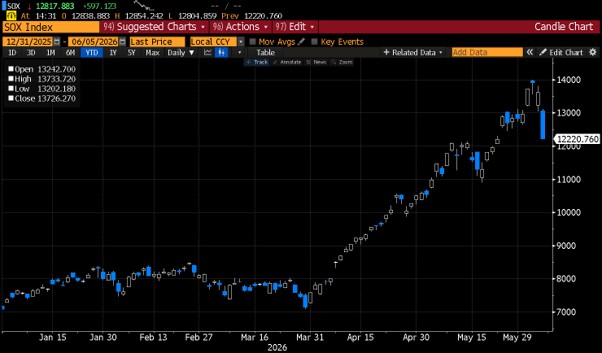
Semi-conductors under pressure
For most of the last week it looked as if the S&P500 was on course to extend its impressive winning streak to ten consecutive weeks of gains but the market action on Friday abruptly changed things. The first sign of weakness occurred on Wednesday with ‘chip’ maker, Broadcom shares falling 8% despite delivering excellent results. This set a mood change in the semiconductor group and triggered sharp retreats in Micron, Intel and Nvidia as investors started to rotate into other sectors.
However, it was not until last Friday that markets really turned sour, as the key Korean stocks, Samsung and SK Hynix, fell sharply pushing the KOSPI index down 5.5%. Taiwan also reversed sharply with Taiwan Semiconductor joining the downward path.
Ahead of the US market open on Friday, the release of monthly nonfarm payrolls report revealed that of 172,000 jobs were added in May, nearly double the consensus analyst forecast of just 88,000. More importantly, positive revisions for the previous two months increased the jobs added by another 93,000. The employment picture is clearly not as soft many feared and has therefore materially changed expectations on interest rates and what actions the Federal Reserve will take under its new chair, Kevin Warsh.
For more than five years, inflation has been well ahead of the Federal Reserve’s target rate of 2% and with the full impact of higher energy costs still to fully feed through to the economy, there is little wonder that money markets are now suggesting a > 70% chance of a 0.25% rate hike to 4% in December this year.
At the start of the year, forecasts were for US rates to be cut to 3% at the yearend! As a consequence of expected monetary tightening and higher inflation, US Treasuries prices have fallen with yields rising and thus placing even greater pressure on share prices of the highly valued Semiconductor index.
What does this mean for investors? Market leadership is likely to broaden beyond semiconductors and artificial intelligence. That would be a positive shift, making markets more stable and less reliant on a handful of high-profile stocks.
Geopolitically, the US and Iran remain in peace talks, but progress is slow as continuing skirmishes in the Strait of Hormuz keep tensions elevated. After 14 weeks of disruption, oil prices have again climbed close to $100 a barrel as confidence in the White House securing an early settlement to the conflict has weakened.
Precious metals came under pressure with both gold and silver retreating sharply despite central banks buying seventeen tonnes in April, led by Poland and China. Higher interest rates are a headwind for assets that do not provide a yield for investors.
The European Central Bank is expected to raise interest rates by 0.25% on Thursday as inflation has climbed back above target due to the conflict in the Middle East. The long-awaited initial public offering of Elon Musk’s SpaceX, expected to raise $75bn, is scheduled for Friday. The company is valued at $1.77 trillion and enthusiasts, and lead managers of the deal, Morgan Stanley asserting that it is a conservative valuation, predicting that earnings could exceed $2.7 trillion by 2040.
(Source: Bloomberg)
Cover image source: Nicolas Arnold