
Defying Gravity
A shortened holiday week did nothing to derail the juggernaut that is America’s bellwether S&P 500 index, which posted an astonishing 9th positive week of returns in a row and has now climbed 20% from the war-driven lows back in March. President Trump’s ability to rehash iterations of a final deal with Iran is something to behold, with markets warmly embracing the latest ‘news’ of a 60-day ceasefire extension.
The tech-laden Nasdaq 100, dominated by AI-related companies that are enjoying a renewed earnings boom amidst insatiable appetite for semiconductors and high-bandwidth memory chips, powered through the psychologically important thirty thousand level for the first time in its history.
Launched back in 1985 at an index price of 126.22, the 30,000 level has taken forty-one years to attain at an annual compound growth rate of 14.7% for a 28,756% total return. Remarkable. The event did not go unnoticed by the Donald, who ‘pressed pause’ on critical domestic and foreign policy initiatives, taking to his Truth Social platform to celebrate the milestone on more than one occasion.
What has also been remarkable is that all four consecutive all-time highs registered by the S&P 500 index last week were coincident with negative breadth, a technical term used to infer that more stocks declined on each trading day than advanced. This has never happened before in history. The narrow participation in this year’s rally caught the attention of several high-profile money managers who have drawn parallels with the 1999-2000 dot.com bubble and subsequent tech-wreck that followed.
For now, at least, the bulls are in control, as spectacular earnings growth from the major technology companies justifies the hype over price moves. The key trend within technology so far in 2026 has been a passing of the leadership guard from the Magnificent 7 (Alphabet, Amazon, Apple, Meta, Microsoft, Nvidia, and Tesla) to picks-and-shovels plays dominating the AI supply chain.
Taiwan Semiconductor Manufacturing Company (TSMC) illustrates the dominance of the AI theme. TSMC acts as the ‘factory for the technology industry’, churning out physical microchips that power modern electronics for key clients including Apple (for iPhones and Macs), NVIDIA and AMD (for artificial intelligence and gaming chips). TSMC now generates approximately 10% of Taiwan’s total economic growth, whilst Taiwan’s semiconductor industry consumes fully 25% of the country’s electricity.
This week, the baton passed to Dell Technologies. Dell reported record financial results that blew through analyst estimates. The highlights were quarterly revenue of almost 44 billion dollars and a tripling of profits, driven by a 750% surge in demand for AI-optimised servers. The company also reported a huge backlog of orders. Investors reacted enthusiastically, sending Dell's stock price up 33% in a single day for its best trading session in company history.
The tentacles of AI have spread to the private market, where Anthropic (creator of Claude Code) is nearing a one trillion-dollar valuation, a tripling in just four months. Claude Code is an AI tool built specifically for data analysts (specialists who use plain-English instructions to prompt Claude to sort through massive databases and generate Excel reports), software engineers (to write code and fix software bugs), and web developers to automate their daily screen tasks.
Outside of equity markets, news of the US-Iran ceasefire extension and hopes of a resumption of commercial shipping traffic through the Strait of Hormuz provided a welcome decline in oil prices. The dated Brent (December 2026 futures contract) price fell to around ninety-three dollars, the lowest level since early March. With that said, the Strait remains effectively closed to enemies of Iran and global inventories and strategic reserves have been rapidly depleted. We may not be out of the woods just yet…
Looking ahead to this week, the US Bureau of Labour Statistics will report jobs and unemployment data on Friday 5 June. The announcement will be parsed and scrutinised by investors for any potential impact on the monetary policy path taken by the Federal Reserve. Its dual mandate of maintaining price stability and maximum employment is becoming a very delicate balancing act.
Chart of the Week: Hot Streak!
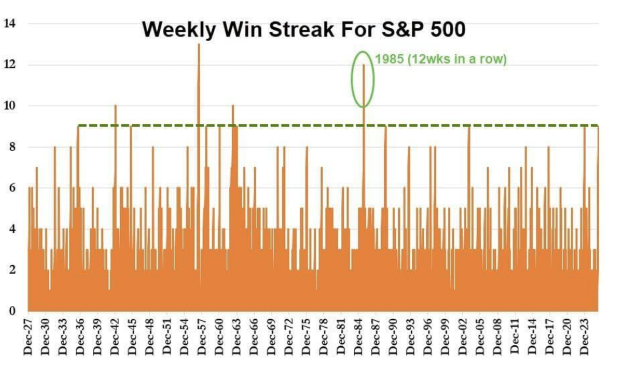
(Source: Bloomberg, Zerohedge)
(Cover Image Source: Miguel Bruna)