
Markets Brace for a Big Week
American shares had a mixed week with the Dow Jones Industrial Average gaining a little less than half of one per cent, but the S&P 500 slipped 0.5% and the technology-heavy Nasdaq Composite fell 0.7%. The week ended on a gloomy note as higher oil prices added to inflation concerns and investors continued to question the cost of funding the artificial-intelligence boom. Technology shares were particularly volatile, while smaller companies and value shares performed better. In short, the wider market did better than the major technology companies consistent with our own strategic positioning.
Most major Asian indices fell over the week despite a partial rebound on Friday. Japan’s Nikkei 225 and Hong Kong’s Hang Seng fell 4% and 4.5%, respectively. Concerns about technology valuations, higher energy prices and global growth weighed on sentiment, although bargain buying helped Chinese, Hong Kong and South Korean shares recover ground at the end of the week.
In Brazil, President Lula narrowly won his fourth election. His first two wins were in 2002 and 2006. He is one of the few democratic leaders to return to the Presidency after leaving office in 2010 and go on to win again in 2022 and 2026. Investors will look beyond the election result itself, wanting to know whether the next administration will have a clear mandate and a believable plan for public spending and debt. A reassuring message could help the Brazilian currency, shares, and bonds.
In the UK, the Budget on Wednesday this week is the main domestic event to watch. Markets will focus on changes to taxes and spending, as well as how the government plans to increase tax revenues and keep borrowing under control. A package that requires more borrowing will inflict more punishment for gilt yields and affect sterling whilst making the Bank of England’s job to reduce inflation more challenging.
The US midterm elections are on Tuesday 3 November. Forecasts are that the Democrats gain control of the House of Representatives (87% probability). However, the Senate remains highly competitive with it being too close to call. The races in Texas, Iowa, Maine, Alaska, and Ohio will be pivotal.
A Democratic-controlled House and a Republican-controlled Senate would probably be the most market-friendly outcome. Although investors do not always welcome political gridlock, it can provide greater certainty by making major legislative and regulatory changes less likely. This would allow businesses to operate with less risk of sudden policy disruption.
A number of central-bank meetings are due this week. The key event will be the two-day Federal Open Market Committee meeting that concludes on Wednesday with a decision on interest rates at 18:00 (UK time). The market has all but discounted no change in rates but expects a rate rise at the next meeting in December. The European Central Bank, Bank of Japan and Bank of Canada all make decisions, but these are less important for global markets.
UK bank results will offer a useful check on the health of households and businesses. HSBC will publish its third-quarter earnings on Tuesday, and investors will focus on revenue, lending margins, credit losses, costs, and the strength of its Asian businesses. Lloyds Banking Group will publish its third-quarter results on Thursday, with attention likely to centre on its net interest margin, mortgage competition, and customer bad-debt charges. Together, the updates should give a useful picture of conditions in both international banking and the UK domestic economy.
In the US, Alphabet, Microsoft, and Amazon are the headline results. For Alphabet, the key areas are advertising, cloud growth, and capital spending on artificial intelligence. With Microsoft, attention will be on Azure, sales from AI products and the cost of new data centres. Finally, focus on Amazon will Amazon Web Services, online retail margins, consumer demand, and delivery costs. Together, these reports will set the short-term direction for the wider technology market.
Across the broader results season it will be interesting to see if companies can raise prices, whether stock levels are under control, and if wages and other costs are easing. Investors will also want to know if companies are maintaining investment plans or becoming more cautious with lower capital expenditure programmes.
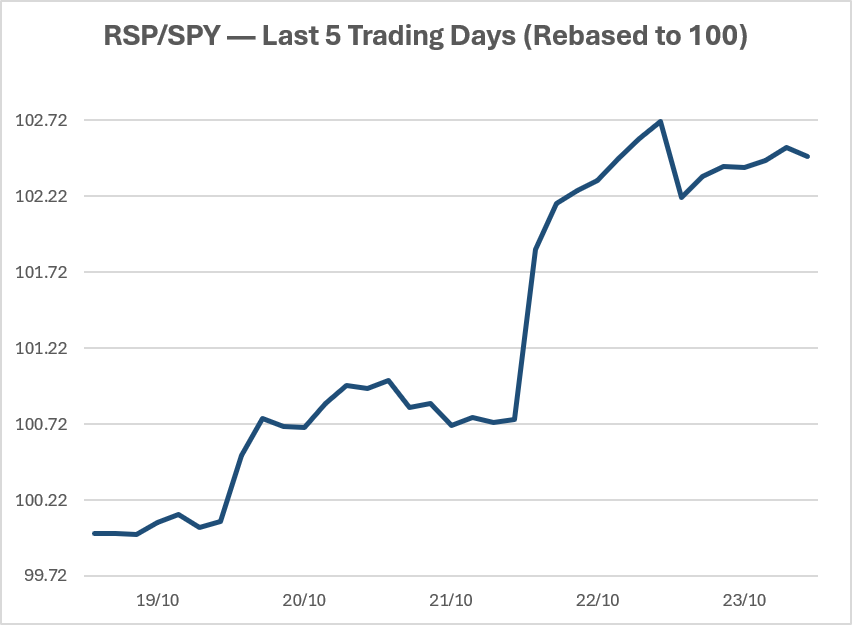
Chart Source: TEAM
The RSP/SPY ratio compares the equal-weighted S&P 500, where every company counts the same, with the standard S&P 500, which is dominated by the largest technology names. A rising line means the average company is outperforming the index giants. Over the week the ratio climbed more than 2%, with the sharpest move midweek, confirming that the wider market held up better than the major technology companies. This broadening of performance is consistent with our strategic positioning.