C.R.E.A.M. – Cash Rules Everything Around Markets.
Markets ended October with an increasingly familiar dilemma, economic growth remains resilient, but inflation and borrowing costs are stubbornly high. That tension was most visible on Wall Street, where strong corporate earnings were no longer enough to satisfy investors questioning the enormous sums being committed to AI. The tech heavy Nasdaq lost 2% over the week, while European and Asian indices generally fared better. Investors are becoming increasingly selective, and the distinction between impressive revenue growth and actual cash generation is starting to matter.
Across the Atlantic, the US expanded at an annualised 3.4% in the third quarter, a notable acceleration from the previous quarter. Yet September’s inflation reached 3.6% by the Federal Reserve’s preferred measure, while household income failed to keep pace with rising prices. Consumers continued spending, but partly by saving less. Against this backdrop, the Federal Reserve held interest rates steady, with two policymakers favouring an increase. The message was clear, robust economic growth offers little comfort if inflation remains difficult to contain, leaving markets betting on a December rate increase.
Energy remains central to that equation. Brent Crude held above $110 a barrel as disruption around the Strait of Hormuz continued. The European Central Bank held rates but signalled further tightening. Rather than anticipating monetary policy relief, investors are having to adjust to a longer environment in which borrowing costs are elevated.
Turning to equites, AI developer Anthropic filed for a Nasdaq listing that could rank among the largest on record, a reminder of how much capital the sector is attracting. Then the hyperscalers reported and the mood turned. The AI narrative has entered a phase, where the key concept is free cash flow. The large cloud and platform companies are spending hundreds of billions on chips, data centres and power. This week they started checking whether the spending is turning into cash and rewarded or punished each company on that basis rather than on headline growth.
Microsoft impressed, with Azure cloud revenues growing 48% and healthy free cash flow despite substantial investment. Alphabet, by contrast, fell almost 13% after disappointing results and a second consecutive quarter of negative free cash flow. Amazons ambitious spending plans also came under scrutiny.
Intel delivered the week’s sharpest decline, falling almost 30% on Friday, its worst trading since the 1970s, after a weak fourth-quarter outlook. Intel’s problem is a second-order effect of the AI boom; data centres are absorbing so much memory that component prices have soared, which makes PCs more expensive and has hit demand, compounded by a factory disruption in Israel. The question is no longer whether AI will transform businesses, but how much shareholders ultimately stand to earn from that transformation.
Thankfully, weakness was not universal. Healthcare, energy and defensive consumer businesses attracted interest as investors rotated away from growth and technology. The indices demonstrated this throughout the month with the Nasdaq declining more than 5% whilst the Dow Jones climbed just under 2%.
Closer to home, the UK’s first budget under Chancellor John Healey was received with relative calm. Fiscal headroom narrowed to £15bn, but the absence of more disruptive measures helped government bonds rally, with the 10-year gilt yield easing to 5.3%. The domestically focused mid-cap index usefully outperformed the FTSE 100, although an increased bank surcharge weighed on lenders. Whilst the market’s reaction was reassuring, the limited fiscal buffer leaves little room for further economic shocks.
In Europe, stocks benefited from their lack of technology exposure, with greater exposure to banks, industrials and energy. The STOXX 600 gained just under 2% on the week, supported by corporate earnings, although concerns surrounding France’s fiscal position continued to keep government borrowing costs elevated, with the 10-year French yield above 5% for the first time since 2002, following last week’s riots over the cost of living.
Turning to Emerging Markets, South Korea’s semiconductor giants benefitted from continued AI related demand. Record profits at SK Hynix helped lift the Kospi, highlighting the contrast between companies funding AI infrastructure and those supplying its essential components. Elsewhere, Brazil proved to be a stark reminder of political risk. President Lula’s re-election triggered a sharp market reversal as expectations of greater fiscal restraint evaporated, with the countries index falling 18% over the week.
Beyond equities, government bonds did their traditional jobs during Friday’s sell off, although persistent inflation continues to limit their reliability as a portfolio hedge. Gold declined around 3% and silver nearly 9%, as higher interest rates increased the opportunity cost of holding assets that generate no income.
Financial markets gasped after $6.3bn of assets were stolen from Binance, the world’s largest crypto exchange, leading to the largest exchange hack on record. The incident reignited concerns surrounding custody, cybersecurity and the trade-offs between decentralisation and asset recovery.
Looking to the week ahead, attention turns to Tuesday and the US mid-term elections. Friday’s employment report in the US and the Bank of England’s next interest rate decision is also uppermost. Finally, investors will be keeping an eye on Iranian peace talks.
(Source: Reuters)
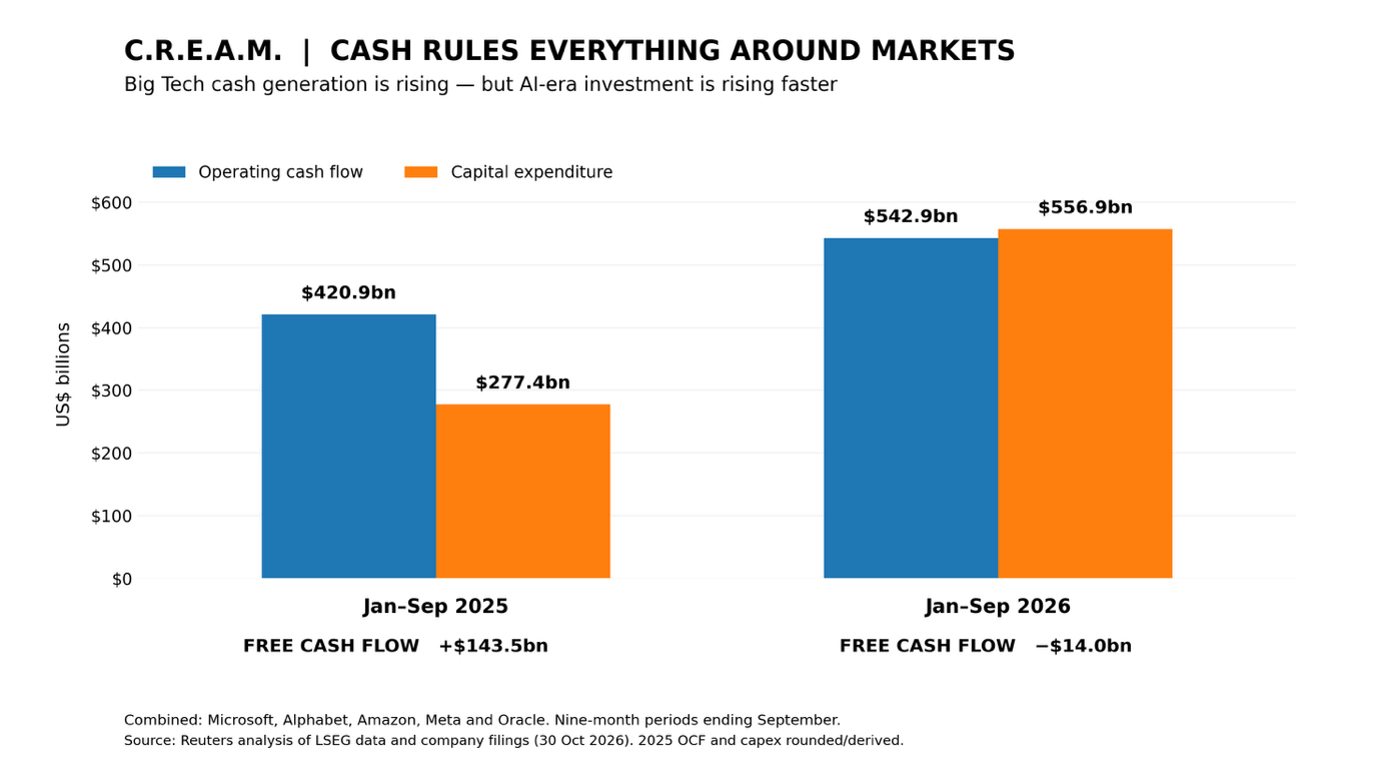
The AI revolution is generating remarkable growth, but its financial demands are growing even faster. Despite record cash generation, five of America’s largest technology companies collectively spent more on capital investment than their operations produced during the first nine months of the 2026. This marks a significant shift in the investment narrative. With borrowing costs elevated and shareholder distributions under pressure, investors are now increasingly asking whether these extraordinary investments will generate equally extraordinary returns. As Wu-Tang Clan famously reminded us, “cash rules everything around me”. Wall Street appears to be rediscovering that lesson.