
A Higher Hurdle
Global financial markets remained under tension last week as recovering equity prices ran headlong into another reminder that the inflation genie has yet to be bottled. Major equity indexes including the S&P 500, the Nasdaq Composite, and the Dow Jones Industrial index all recorded gains of over 2%. A welcome change of direction, but bond markets were in no mood to join the party.
In corporate news, the week’s standout development was the shock resignation of Nvidia co-founder and chief executive Jensen Huang, with chief financial officer Colette Kress stepping in as interim CEO. The fluid situation at one of the biggest corporate success stories in history adds further pressure to an AI story already wobbling on account of valuations and the financing of its enormous infrastructure ambitions. Smaller cloud providers and data centre operators reliant on external funding look most exposed to any slowdown.
That was evidenced by CoreWeave’s earnings results and guidance. Third-quarter revenue reached $3.7 billion and contracted revenue backlog stood at approximately $133 billion, clear evidence of substantial customer commitments. Yet the company also reported a $709 million net loss and $846 million of net interest expense, against operating income of $207 million. Backlog is not cash in the bank: the company explicitly noted that recognition depends on delivery and service availability.
Europe provided a useful reminder that the equity universe extends beyond the AI supply chain, with mainline indices offering shelter from the week’s corporate drama. The STOXX Europe 600 gained more than 2% over the week, its strongest advance since late June, with euro area banks rising more than 4%. Banks and insurance companies are extremely well capitalised following enforced regulatory enhancements over the past two decades, whilst also offering cash flow and earnings visibility.
On the inflation front, US consumer prices increased +0.4% MoM (month-on-month) in October, down from September’s +0.6% MoM but hardly the all-clear investors had been hoping for. Core prices, which exclude food and energy, rose +0.3% for a third consecutive month. Shelter, food, and energy prices all contributed to the increase, suggesting that the squeeze on household budgets remains broader than just the price at the petrol pump.
By the end of the week, markets had fully priced a December US Federal Reserve rate increase, with roughly 10% odds of a larger, half-percentage-point move following hawkish comments from Fed Governor Christopher Waller. Friday’s producer price report offered only limited relief: the monthly increase moderated to +0.3% MoM, but annual producer inflation accelerated to 6.5% YoY, its fastest pace since November 2022. Treasury prices fell as yields rose sharply, particularly at the shorter end of the curve.
Geopolitics remains front and centre. Early optimism over US-Iran negotiations, mediated by Qatar and other regional players, faded after President Trump said the US ‘did not need a deal’ and was redirecting Vice President JD Vance’s efforts elsewhere. Brent nonetheless remained below $100 per barrel, offering some much-needed breathing space for businesses and consumers.
There were also tentative signs of a breakthrough in Ukraine. Russia, Ukraine, and the US held talks in Abu Dhabi covering security arrangements and territorial questions, with both Ukrainian and Russian representatives sounding more constructive. US envoy Jared Kushner nevertheless cautioned that an agreement would take time. Encouraging language is a welcome development, but markets are yet to see concrete evidence of an enforceable peace. Looking ahead, the central question is whether corporate earnings can continue to clear an increasingly demanding interest-rate hurdle. We will be watching the breadth of inflation pressure, the resilience of consumer demand, and whether AI-related companies can translate ambitious order books into sustainable and meaningful cash generation for long term shareholders.
Chart of the Week: déjà vu?
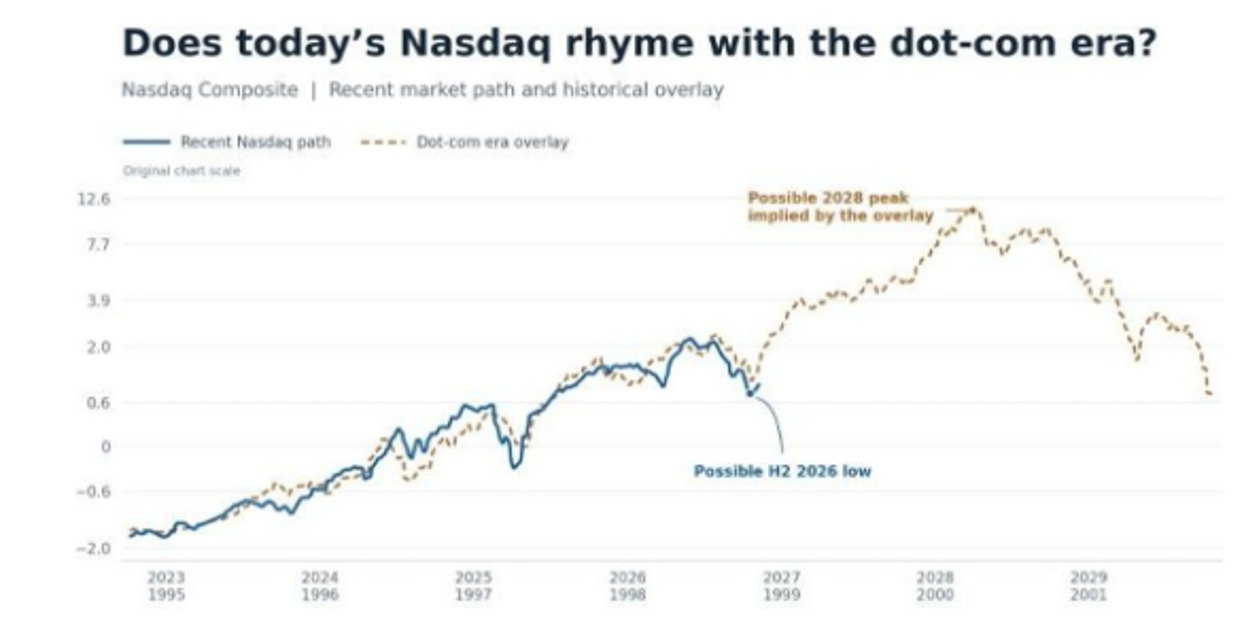
(Source: Ned Davis Research)
The chart compares the Nasdaq’s recent AI-driven rise, associated with ChatGPT, with its climb during the mid-1990s internet boom, when Netscape helped popularise web browsing. That dot-com bubble peaked in 2000. If the pattern continued, it would suggest a bumpy spell before another strong rally, with a possible peak around 2028. Caveat: this is a historical comparison, not a forecast. History rarely repeats perfectly, but it can often rhyme.