From FOMO to FOGO: Markets Reprice the AI Trade
Global financial markets experienced a challenging week, driven by a sharp correction in technology and semiconductor stocks. Investor sentiment weakened amid growing concerns over the sustainability of AI-related capital expenditure, increasing regulatory scrutiny, and stretched valuations across parts of the technology sector. The resulting sell-off led to the largest weekly decline in technology shares since the market turmoil of March 2020, during the early stages of the COVID-19 pandemic.
Technology and Semiconductor Weakness
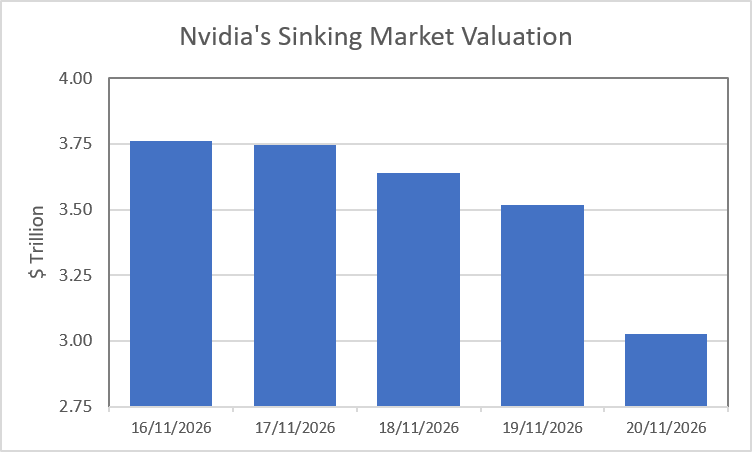
The sell-off was led by Nvidia, whose shares fell approximately 23% over the week, including a 14% decline on Friday alone. The company has seen around $2.75 trillion erased from its market value over the past six weeks, leaving its market capitalisation at approximately $3 trillion. Reports that the U.S. Securities and Exchange Commission is examining aspects of the company's accounting and disclosure practices added to existing valuation concerns and prompted a broader reassessment of AI-related investments.
Weakness quickly spread across the semiconductor sector, with companies including AMD, Micron Technology and Broadcom also recording significant losses. Investors increasingly questioned whether the substantial levels of investment being directed towards AI infrastructure will ultimately generate returns sufficient to justify current market expectations.
Adding to investor unease were ongoing concerns surrounding U.S. export controls on advanced semiconductor technology. Reports suggest some Chinese technology firms continue to access high-performance Nvidia computing capacity through overseas data centres and cloud service providers, highlighting the practical challenges of restricting access to advanced AI infrastructure. This has reinforced uncertainty around the effectiveness of existing export controls and the potential for further regulatory intervention, creating an additional headwind for the sector. Anthropic's highly anticipated IPO also highlighted growing investor caution towards the AI sector. Despite a heavily oversubscribed order book, the company increased the size of the offering by 19% and priced shares above the marketed range, raising a record $81.3 billion. Although the stock opened more than 30% higher, early gains faded during its debut trading session, and the following day.
The speed and scale of the broader sell-off suggested a notable shift in market psychology. For much of the past two years, investors have been driven by FOMO (Fear of Missing Out), particularly around the artificial intelligence theme. Last week, however, FOGO (Fear of Getting Obliterated) appeared to take hold, as investors rushed to reduce exposure to some of the market's most richly valued technology stocks.
U.S. Equity Markets
The technology correction weighed heavily on broader equity markets. Both the Nasdaq Composite and Nasdaq-100 declined by more than 10% over the week, marking their worst weekly performance since March 2020. The S&P 500 entered correction territory, while the Dow Jones Industrial Average also moved lower as risk aversion extended beyond the technology sector. While demand for AI computing capacity remains robust, investors appear increasingly focused on profitability, cash flow generation and returns on invested capital, rather than revenue growth alone.
International Markets
The weakness in U.S. technology stocks reverberated across global markets. Asian equities, particularly those with significant semiconductor exposure, underperformed, while European technology shares also came under pressure. The reassessment of the AI investment cycle contributed to a broader reduction in global risk appetite.
Fixed Income and Defensive Assets
Government bonds proved relatively resilient as investors sought higher-quality assets amid increased market volatility. Credit spreads widened modestly, although there were no signs of broader stress within credit markets. Defensive assets delivered mixed performance, with precious metals providing less protection than might typically be expected as some investors favoured holding cash during the sell-off. Despite the sharp moves in equity markets, fixed income markets remained orderly, suggesting that recent volatility reflects a significant repricing of growth expectations and valuations rather than concerns over systemic financial stability.
Source: TEAM