CIO Alert: Cloaked in the Fog of War
‘You never like to say too early you won. We won. In the first hour it was over’
(US President Donald Trump, Kentucky Rally, Wednesday 11 March 2026)
Midway through March, global financial markets find themselves cloaked in the ‘fog of war’, a term that originated from the writings of Prussian military theorist Carl von Clausevitz nearly 200 years ago. In essence, it refers to heightened confusion and a state of temporary blindness brought about by the stress, speed, and the spread of misinformation experienced during a conflict.
Three weeks in, and Operation Epic Fury continues its metamorphosis from a surgically precise first strike on Iran’s military and leadership apparatus by US and Israeli forces into a developing and confrontational regional war involving new actors, and significant humanitarian and economic consequences.
For markets seeking to appropriately price assets and risk real-time, that job has been made harder still by American and Israeli leadership pursuing diverse strategic objectives, a slew of contradictory public statements from decision makers inside the US administration, and the unwillingness of NATO members to commit military support in the region.
Perhaps most unhelpfully, whilst investors know what Iran’s end goal is (survival), America’s ultimate objective remains unclear.
Amidst the unfolding tragedy, Iran’s regime remains in place despite suffering catastrophic personnel and organisational losses, including the dismantling of the top tier of its religious, political, and military command.
The list of high profile casualties includes the Supreme Leader Ayatollah Ali Khamenei who ruled Iran from 1989; Ali Larijani, the Intelligence Minister, otherwise known as Iran’s ‘strategy chief’, and Mohammad Pakpourhe, head of the Revolutionary Guard (IRGC), Iran's most powerful elite military force.
Although the so-called ‘decapitation strikes’ have left a vacuum in Iran’s power structure, the remaining leadership has been projecting an image of stability whilst simultaneously doubling down on its most aggressive counter-response tactics.
Economic Sabotage
Its most potent weapon, considered by Gideon Rachman of the Financial Times to be …’one of the most foreseen ‘unforeseen problems’ in history’, has been to functionally close the narrow, 21-mile passage known as the Strait of Hormuz, halting nearly all maritime traffic and triggering a massive global energy crisis.
The closure has been achieved through a ‘selective blockade’ strategy that; 1) targets any vessel attempting to transit without permission with anti-ship missiles, Shahed drones, and fast-attack boats, 2) requires ships to navigate thousands of naval mines planted along the Strait, and 3) scrambles navigation systems via constant GPS jamming. Rudimentary, but extremely effective, guerrilla warfare tactics.
In addition to the physical threat posed to boats and crew wishing to pass through the Strait, the initial military strikes caused major global insurers to outright cancel war-risk cover for the Gulf, making it financially unbearable for commercial operators to risk the passage.
As the world’s most critical oil and fertiliser chokepoint, the Strait’s importance cannot be understated: approximately 20% of the world’s oil and 25% of seaborne oil pass through daily (an estimated 20 million barrels), in addition to c.30-50% of global fertiliser exports, essential inputs for food staples including wheat, rice, and maize.
Sporadic warfare
In parallel, Iran launched ’Operation True Promise IV’, a series of ballistic missile and drone swarms targeting major cities in Israel and U.S. military bases across Qatar, Bahrain, and the UAE. Yesterday’s strike on Qatar's Ras Laffan gas complex caused ‘extensive damage and massive fires’ that could take months or years to repair according to experts. This latest bombardment marks a significant escalation in the conflict.
Located in Qatar, Ras Laffan is essentially the world’s central ‘gas station’ for liquefied natural gas (LNG). It is the largest facility of its kind and provides about 20% of the entire planet's supply. Because there are no pipelines to move this gas, every drop must be processed here and shipped out through the now-blocked Strait of Hormuz.
For many countries in Europe and Asia, this single site is the primary source of energy used to heat homes, power factories, and generate electricity. By crippling Qatar’s ability to export gas, Iran is successfully sending a ‘shockwave’ through the global economy, making everyday energy costs much higher for consumers worldwide. That is being reflected in the surging price of oil and gas today as investors rapidly reprice the supply outlook for markets.
Calm or complacent?
One of the oldest axioms in investing is that Mr Market hates uncertainty. Yet, against the backdrop of arguably the greatest potential oil and gas disruption in history, and with events in the Middle East seemingly moving from bad to worse with each passing day, markets have broadly behaved themselves.
Yes, risk assets, led by equity markets, have corrected, but not significantly. Bond yields have risen sharply over the three-week period since Operation Epic Fury commenced, but we are not even close to what could be considered ‘crisis’ levels when looking at similar historical episodes.
The prevailing narrative seems to be hanging its hat on three factors. First, that corporate earnings remain in decent shape, and that is ultimately what investors care about. Second, that the Middle East conflict will conclude any day soon, as it is in the interests of both the US and Iran to find an ‘off-ramp’ and move towards de-escalation. Third, central banks will remain broadly accommodative.
All three positions are now being challenged. Let us consider them in reverse order.
On Hold
Amidst a Central Bank ‘super week’ which involves no less than 18 separate interest rate decisions globally, the mighty US Federal Reserve left rates unchanged (as universally expected) yesterday. And, whilst the governors updated their projections for the fed funds rate and the main economic indicators in the closely watched ‘dot-plot’ forecast, Chairman Powell explicitly told market watchers to ignore it.
Powell’s appraisal of the current situation was straightforward and succinct. He stated: ‘the implications of developments in the Middle East for the US economy are uncertain’.
Crucially, the war has slashed hopes for further rate cuts. On the eve of the initial Iran strike (27 February 2026), markets were pricing three further US rate cuts of 25 basis points each in the next 18 months. That has since been reduced to one cut. More worryingly, each of the nine other largest developed market central banks is now forecast to raise interest rates over the next twelve months. Should the Middle Eastern conflict continue into the second quarter, we might expect the Federal Reserve to join the hiking party.
De-escalation
A prolonged Middle East conflict was not in the MAGA (‘Make America Great Again’) script. It would be nothing short of catastrophic for an incumbent US President that entered the war with disastrous approval ratings and unrest amongst his core voting power base. Most Americans are opposed to the conflict and sceptical of flimsy evidence that Iran posed an ‘imminent strategic threat’ to justify the initial US-Israel joint attack.
Critical US mid-term elections take place in November, with the thorny issue of (un)affordability front and centre for voters. Gas prices at the pump in America, an emotive and often decisive issue in deciding the fate of Presidents, have surged approximately 30% in three weeks. This impact will almost certainly feed into broader inflation measures for the rest of 2026.
From a foreign diplomacy perspective, the decision by Trump to proceed with pre-emptive missile strikes was taken without consulting allies and strategic partners in the Gulf region. Many of these countries now find themselves victims of Iranian missile and drone attacks by association. This sudden evaporation of trust may take a long time to rebuild.
With each passing day that the conflict ensues, the pressure on the Donald to de-escalate ratchets up.
We are very much ‘armchair generals’, not military strategists, but a coordinated climbdown masked as an outright victory for Team USA could take several forms, including, but not limited to,
Victory Declaration. The U.S. could claim primary military objectives, such as destroying Iran’s naval fleet and degrading missile sites, are achieved, allowing for a strategic withdrawal from a ‘surgical strike’ scenario.
Neutral Mediation. A negotiated off-ramp via intermediaries like Oman or Switzerland, requiring Iran to halt uranium enrichment and accept intrusive inspections in exchange for a ceasefire and the reopening of the Strait of Hormuz.
Regional Security Framework. Establishing a joint committee with Gulf states for maritime security that would permit Iran to halt retaliation under a regional, rather than Western-led, security arrangement, enabling a face-saving resolution.
Global Economic Bargain. A deal brokered by major powers, such as China, could link the restoration of oil flow through the Strait of Hormuz to limited sanctions relief, providing a necessary economic lifeline for Iran.
Corporate earnings
Coming into the war, corporate America was experiencing something of an anomaly. Rather than analysts following the traditional path of tapering expectations for full year earnings and margins through the first three quarters of the year, the sell side community was actively lifting them to record highs during January and February.
A lot has changed in a short space of time. Markets are jittery, focussing their attention on:
1) an extended period of global energy supply disruption and potential negative impacts to global growth,
2) higher inflation for consumers, businesses, and economies that are import-dependent for their energy needs,
3) the prospect of a long, drawn-out conflict, and
4) the potential long-term confidence shock to businesses and consumers.
Ultimately, the war is being widely interpreted as throwing sand into the gearbox of an already slowing global economy, whilst adding considerable uncertainty to the macroeconomic picture.
Some Better News
From an investment building blocks perspective (Macro, Sentiment, Technical, Valuation), the sell-off YTD has led to some proverbial ‘green shoots’ appearing. We are not suggesting an important low is ‘in’, but, like a rubber band that has been fully extended, a short, sharp snap-back in the opposite direction, in this case to the upside, becomes a growing possibility.
Macro: 2025 federal tax receipts, in our humble opinion the best barometer of US economic growth, were up more than +10% year-on-year. This does not reek of a sharply slowing economy. Expect the Trump administration to continue with unconventional monetary and fiscal policies in a not-so-subtle vote winning effort through the course of this year. If America can side-step a recession in 2026, odds of positive equity return twelve months out from here greatly improve.
Valuation: Whilst it cannot be argued that US markets are cheap, many international markets have returned to attractive prices in an absolute and relative context. The sharp move higher in fixed income investment grade and high yield corporate spreads (the additional yield compensation demanded by investors owning ‘riskier’ bonds over government bonds) has created attractive opportunities in credit selection.
Sentiment, as measured by the CNN Greed and Fear gauge is at a ‘22’ reading currently, indicating extreme fear, whilst the 3Fourteen Daily Sentiment Index, shown below, currently reads 26.9. Both measures are closing in on levels typically associated with capitulation lows.
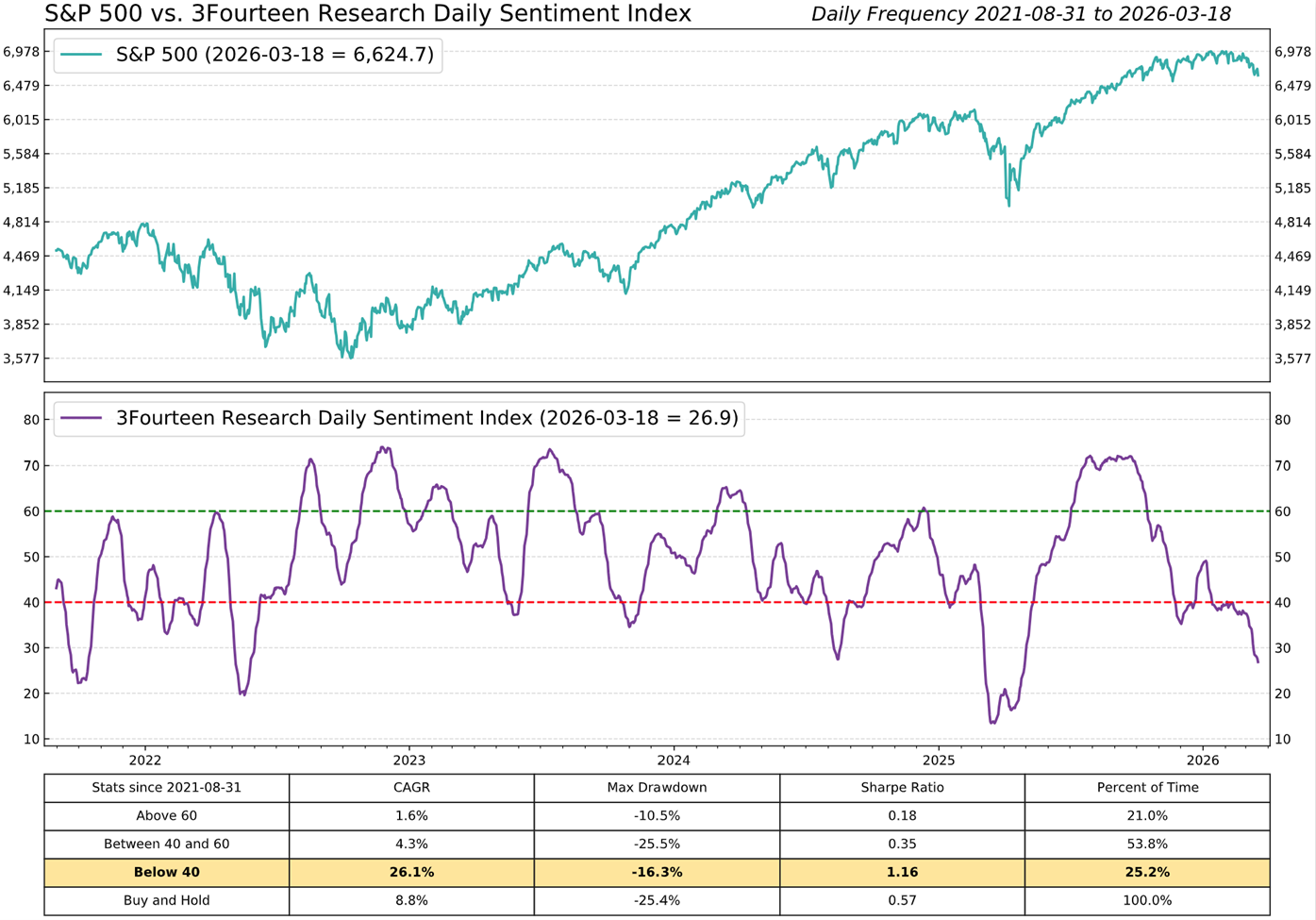
Technical: Retail inverse (short) ETF buying as a percentage of overall ETF buying has hit the ‘45’ level, suggesting Joe Public is shouting to buy house insurance after the family home has caught fire. From a contrarian perspective, we are approaching an area that points to greatly improved odds of positive equity return twelve months out from here.
What Have We Done for Our Clients?
Coming into March, healthy levels of cash and cash proxies (a blend of ultra short-dated bonds, absolute return funds, money market instruments) were held for lower and medium risk clients, providing important ballast to portfolios in this current sell-off episode.
We previously outlined the value that oil exposure can bring to a multi-asset portfolio in prior commentaries. This includes a unique source of return and diversification benefits.
Pleasingly, direct exposure to both the oil price and leading energy sector equites (via ETFs) are owned across the multi asset range in meaningful size, which has also helped to buffer portfolios. The longer the conflict persists, the greater the potential for the major energy sector companies to rerate as both revenues and operating margins are lifted materially higher.
The net result is that the TEAM multi asset range has weathered this latest storm reasonably well, keeping our Conservative, Balanced, and Growth MPS solutions at a 5%+ return year-to-date.
Conclusion
TEAM’s framework and process suggest that we are not through the woods yet in terms of the current market unwind.
Whilst it may be cold comfort for clients, we are a lot closer to a meaningful low for markets than this time last week, and we have, thus far, managed to restrain portfolio volatility and draw down losses within the tramline guidelines of each of our mandates.
We anticipate better opportunities ahead to lean back into risk assets in meaningful size in the coming weeks and will communicate strategy changes with you accordingly.
As always, your ongoing support is much appreciated.
(Cover Image Source: Emily Schultz)